วันศุกร์ที่ 12 พฤศจิกายน พ.ศ. 2553
Another easy way to get blog jobs is to approach other bloggers.
Here are five topics for research in education. The perfect gift for the college student wondering what to select as a topic, or the educational professional seeking to enlighten us with a breakthrough or two.
What nutritional elements elevate learning abilities?
Are there foods that aid in the educational process? Certainly there are foods to be avoided, such as an excess of sugar and the caffeine laden drinks that send my fourth grade students bouncing off the walls. There are the “New Age,” well intentioned, but ill informed folks, who would have us eat nothing but dandelion leaves. There are the hucksters promoting their “overnight weight loss/increased sex drive/mind calming/IQ enhancing wonder diets,” each bearing the disclaimer, “these findings are not substantiated by scientific research.” But is there any real scientific data out there? I’d be fascinated to learn.
What methods most greatly encourage elementary school students to read for pleasure?
What is the psychology behind the impetus some students feel, and some students will never experience? Is there a proven existent paradigm for greater success? What are the latest and most promising approaches? How do I break down the reluctant reader and infuse them with a least a cursory desire to read? All of these questions spark my intense interest.
Are newly arriving freshmen college students better or more ill prepared academically than 1966’s freshmen?
Educators decry the state of affairs of all things educational, and routinely proclaim a crisis is coming or already upon us. But just as every generation in America has resisted and maligned the favored music of their offspring, I suspect this educational outrage is equally ongoing and unending. Is there data supporting the claims that today’s freshmen are more ill equipped to deal with college life?
How does physical movement benefit brain development in elementary students?
I was amazed to learn of the correlation between regular physical movement and brain development in young children. What programs exist that would aid in my bringing movement - and by extension, greater brain development – to my students? What are the latest research findings on physical education’s impact on other areas of learning? What is the physiology involved?
How does art instruction influence other academic progress?
I infuse all my courses with art, and have found it tremendously helpful in capturing the attention of my students. I want to learn more about how art impacts student development, both to make myself better able to utilize this tool and to give myself greater justification for using it. I want to glean all the latest and most well documented research that supports my view that art instruction compliments all other subject lesson planning, captures the attention of a segment of students who would otherwise remain apathetic, and broadens the academic universe of all students.
As this is one of my own personal favorite topics, I'll throw in a thesis, free of charge. “Art instruction in elementary school curriculums – often among the first targets of politicians seeking to balance budgets – is a powerful and practical educational tool, with far reaching and often underappreciated benefits.”
Possible subtopics include art as a means to reach at-risk and otherwise educationally challenged students; how art instruction gives students a welcome respite from more difficult subjects, re-energizes and makes them better able to focus; how art education compliments and augments standard educationally required subjects; statistical data suggesting (or proving) that students who receive instruction in art have higher grades and do better on standardized tests (assuming this is demonstrable).
Let's see some data collecting out there!
Reference research: business research and home research and shopping research and recent update
social bookmark

วันจันทร์ที่ 8 พฤศจิกายน พ.ศ. 2553
research groups
The similarities between scientific research and criminal investigation are the search for the conclusion or a cause of the effect. Both scientists and criminal investigators are specially trained in their field of practice. They tend to use similar methods of research and investigation the cause. Scientists as well as investigators both observe the surroundings, the facts, the areas involved in the research or investigations. They classify the data into categories this can be as simple as determining if it is valid or not valid. There is the use of logic, the formation of a hypothesis or a theory as to why and what has occurred. Both sides must link information together to prove their hypothesis or conclusions. Both scientists and criminal investigators work in a systemic method which seeks accurate answers, not general conclusions.
So how can you tell which is which? It's not really that difficult once you understand the basic principles. Scientific research is a type of investigation which is systemic and basis its research on scientific methods which have been used in the past, and in relation to the scientific field. This type of research can be described as well organized, methodical, and precise. Scientists begin with an idea, a theory or a hypothesis. Scientists begin with an observation or description about what they intend to study/research. From these observations they form a hypothesis to explain their subject. They use the hypothesis to predict what may happen in the course of the research. The scientist begins to experiment or run tests based on their predictions about the hypothesis. They may also collect data about their observations to show that the hypothesis is either valid or not.
.
Criminal investigations begin with gathering documents and information. They begin to evaluate the facts about the events, or the crime. They use a systemic method to observe the details of the crime, as in who what where when why and how. They begin to piece things together, by assembling the facts and determining if the evidence gathered is useful or not. The hypothesis begins to form at this point which helps to link all the information gathered to the crime. The hypothesis in this sense is used to create a theory as to what happened, and the ability to define what has occurred. The hypothesis is an important part of the criminal investigation. The reason is that the investigator must prove or disprove the theory/hypothesis. Even more important for the investigator is to find the missing pieces, that are not ready available at the time. The investigator must be able to draw conclusions about the events but they must also be able to prove that the events did in fact occur.
Reference research: beauty research and health research and travel research and my bookmark page
Topic Webboard
วันศุกร์ที่ 5 พฤศจิกายน พ.ศ. 2553
magnum research
Researchers are currently testing an artificial blood on unconscious patients and this is creating an ethics debate. The artificial blood is called PolyHeme and is made by Northfield Laboratories. Ethicists have weighed in on both sides of the ethics question.
The artificial blood has been tested in earlier hospital studies and most have shown it to be safe. However, there was one study on PolyHeme that was halted after 10 of 81 patients given it had heart attacks and two died. None of those receiving standard treatment had a heart attack. Those who are concerned about the ethics of the current study have pointed out that no one is being informed of this study.
The research on artificial blood works this way. The community where the testing is to be done is informed by researchers about the study. Those who do not wish to be part of the study in case they have a serious accident can opt to wear a special bracelet. If paramedics see no bracelet, they open a sealed envelope that tells them to give either a standard saline solution or the artificial blood. The artificial blood continues to be given for 12 hours once the patient reaches the hospital. There are several ethics problems posed by the research. In the first place, the community is really not being well informed about the existence of the test on artificial blood.
In 1996 Congress passed a law that allows a bypass of the rules on informed consent when dealing with an emergency, potentially life saving research. Supporters point out that PolyHeme, the artificial blood, could save as many as 100,000 lives a year in the U.S. Dr. Richard Garnellie says we don’t ask permission to commence CPR and that the ethics of testing artificial blood falls in the same area. “We kind of have a social contract to do the right thing already.”
Kelly Fryer-Edwards who studies ethics at the University of Washington Medical Center says that it would be difficult to find people to volunteer for a study of trauma patients because people don’t like to think about being in an accident. However, she feels that the attempt has been made to get informed consent. “You’re putting the responsibility on the person who wants to opt out…you have respected their autonomy by giving them that choice.” She feels that emergency research makes all approaches to research ethics go out the window—protecting subjects, getting informed consent.
Vera Sharaw, president of the Alliance for Human Research Protection is opposed to the research on artificial blood on ethical grounds. She says the study “is another one along that slippery slope that’s essentially demolishing your individual right not to become experimental subjects unless we give prior, voluntary, informed, comprehending consent.” She feels that the people who want to be in the study should be the ones wearing the bracelets.
Nancy King of the University of North Carolina has a third ethics concern. She agrees with those who support the experiment to use artificial blood in the field where blood can’t be typed. However she is opposed to its continued use for twelve hours after the patient has reached the hospital where it takes 20 to 30 minutes to type blood. She points out that giving human blood is the current standard of treatment once the patient reaches the hospital.
Several ethicists have pointed out that those most likely to be subjects of the research are from disadvantaged communities.
The University of California at San Diego School of Medicine has come up with the following questions for those interested in the ethics of research into artificial blood in emergency situations:
1. What ethical issues does this case raise for the process of informed consent?
2. Was the waiver of consent that exists for research involving emergency treatment appropriate in this case and if so, why?
3. From the community standpoint, who speaks for the interest of (potential) participants? Should more have been done to ensure their safety and well being and, if so, what?
4. In what circumstances, if any, is it ethically acceptable to draw a disproportionate share of its subjects from a disadvantaged community?
These are all good, difficult questions that should be answered by anyone interested in the ethics of giving artificial blood in emergency situations.
Reference research: beauty research and home research and shopping research and my bookmark page
blog
วันพุธที่ 3 พฤศจิกายน พ.ศ. 2553
Autoresponder Service - AVOID free ones
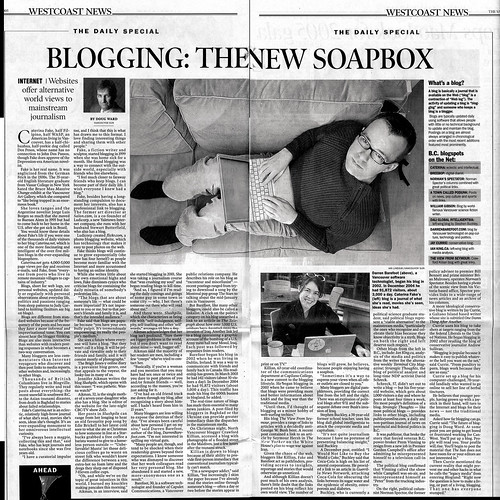
So you think blogging is easy huh?
Well you may be right if you're speaking about the United States and/or any other western country - but in China - Wei Wenhua was beaten to death simply because he was taking a photograph.
Was he photographing a violent gang war? Was he perhaps leaking secrets out of the country?
No, it was none of these. In fact it wasn't for any reason that you might imagine. According to the Xinhua News Agency, Wei was beaten to death by city inspectors who were involved in a fracas with local villagers on Monday.
The Xinhua News Agency is the official press agency of the government (employing 10,000 people) in the People's Republic of China (PRC.) There is only one other, called the China News Service.
The Chinese internet chat rooms are filled with rage, with thousands of people expressing their anger at the killing of Wei, a forty-one year old executive of "Water Resources Construction Co."
Qi Zhengjun, chief of the urban administration bureau in the city of Tianmen, lost his job over the incident, Xinhua reported Friday. No details known as yet as to why he lost his job and what his involvement might have been. Police have detained 24 municipal inspectors and are investigating more than 100 in the violent death of Wei Wenhua.
The killing has also drawn the (angry) attention of an international freedom of the press group: Reporters Without Borders. In a statement, they said:
"Wei is the first 'citizen journalist' to die in China because of what he was trying to film."
"He was beaten to death for doing something which is becoming more and more common and which was a way to expose law-enforcement officers who keep on overstepping their limits."
While he was literally being beaten to death, the man who had been in the car with Wei - Wang Shutang, said that Wei was shouting that he would delete the pictures and hand over his phone. Another eyewitness said he could hear Wei scream: "I surrender!"
Still this didn't stop the murderers, also known as "urban management officers" or cheng guan. The central Chinese province of Hubei was the world stage for this horror and all because villagers were protesting the continuation of waste being dumped near their homes.
When the trucks began unloading the rubbish anyway, a scuffle developed beween the city inspectors and the villagers.
Wei had been trying to record the protest by filming the violence with his cell phone, when more than fifty municipal inspectors turned and beat on him for five minutes. Five minutes would seem like an eternity in such a situation. The blogger was dead on arrival at the Tianmen hospital.
The Northeast News web site has an editorial condemning the violence:
"It's no longer news that urban administrators enforce the law with violence ..."
"But now someone has been beaten to death on site. It has brought us not surprise, but unspeakable anger."
The latest news is that more than one hundred people are being investigated by the police and four have been detained."
Sources:
CNN.com/Asia
http://edition.cnn.com/2008/WORLD/asiapcf/01/11/china.blogger/index.html?iref=topnews
Wikipedia
http://en.wikipedia.org/wiki/Xinhua
Virtual Review:
http://virtualreview.org/china/zoom/442088/100-odd-investigated-for-beating-man-to-death
Source article: Blogger Reviews and Blogger Magazine and Professional Blogger and free blogs and Blogging Host
Wordpress Adobe Illustrator Tutorial
สมัครสมาชิก:
บทความ (Atom)
